The Greek reenactment is a broader category of products found in historical excavations and dated to the Greek era. The products range from the early Greek to the early Roman Empire because the design and utility were transfused between different timelines.
The category of Greek reenactment has Greek helmets, greaves, clothing, footwear, and even display weapons. We make our replica products in close relation to their museum replicas.
-

6th Century Bell Cuirass | Greek Bell Cuirass
Price range: $330.00 through $450.00This product has multiple variants. The options may be chosen on the product page6th Century Bell Cuirass is a special piece of body armor that is believed to have been used between the 4th and 6th centuries. It is an inspiration from the famous and widely used Greek Bell Armor and has similar features. The abdominal curve is very similar to a Greek bell cuirass but it flares outside more than the original bell armor. The Pectoral muscles also have embossed spirals in the same shape as the abdomen, it gives the cuirass a well-defined style. The collar is added to the neck to give an additional aesthetic to the cuirass.
Our replica has hinges and rings on both sides but it can also be made with fixed hinges on the right-hand side only. The left side has overlapping front and back plates, fixed tubes through which pins go to fasten the cuirass tightly.
-
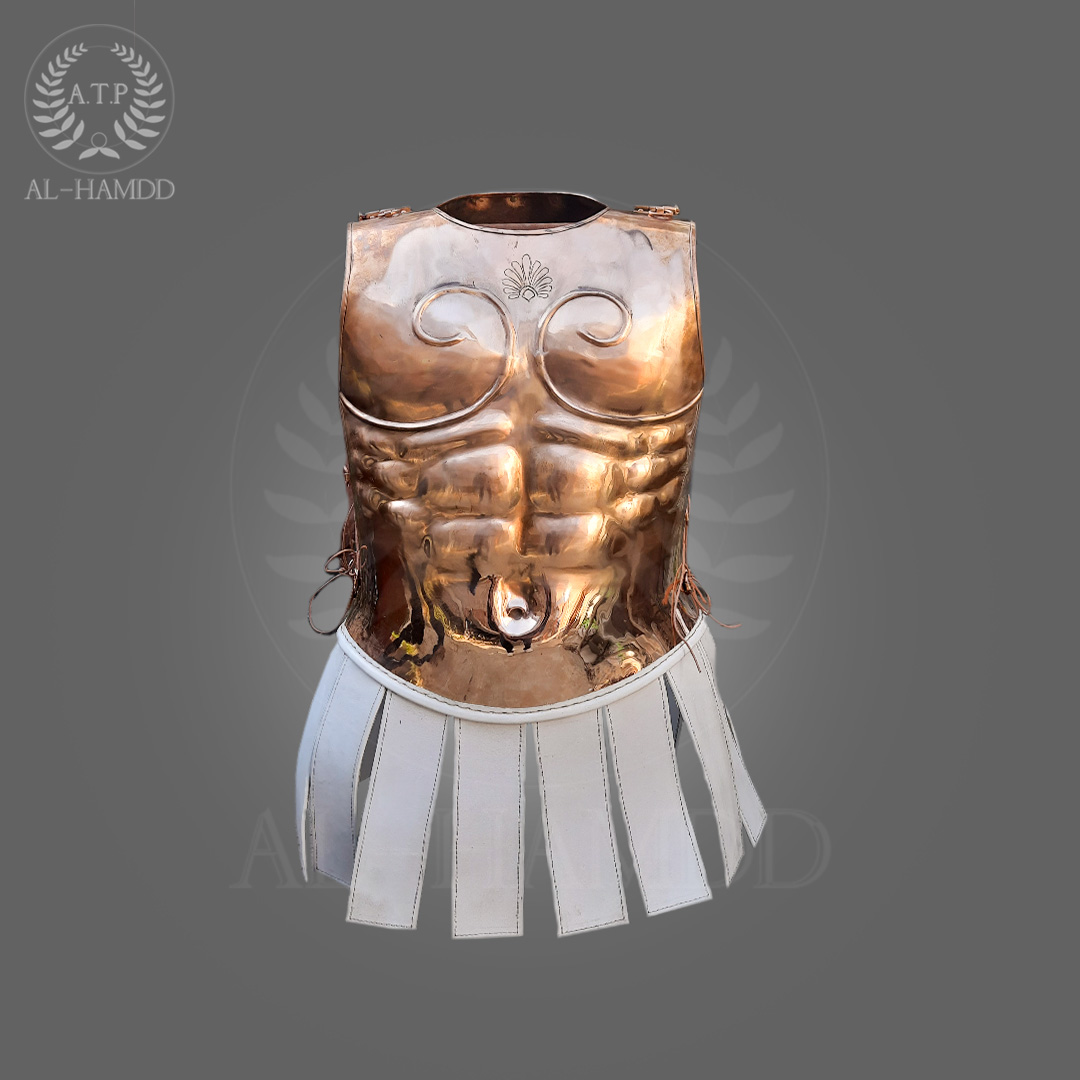
Anatomical Muscle Cuirass | Palermo Museum Replica Cuirass
Price range: $375.00 through $499.00This product has multiple variants. The options may be chosen on the product pageKey Points –
– ‘Made-to-Order’
– Tailor-Made Armor available
– Our armor closely fits a chest size of 100-105cm.
– Length (without Pteruges) – 55cm
– Length (with Pteruges) – 75cmDescription –
The Anatomical Muscle Cuirass was used during the Late Greek period by the Hoplite warriors. This type of armor is shown in one of the vases showcased in the Palermo Museum. The armor was designed to show/highlight the natural muscle structure of the human body. The overall design of human muscles varies in different designs of the armor but follows the root idea. Our replica has muscles in the front as well as the back. The rear of the armor does not have any projecting muscles but the overall shape reflects a human body shape. -

Apulian Corinthian Helmet | Italian origin helmet
Price range: $200.00 through $300.00This product has multiple variants. The options may be chosen on the product pageKey Points –
– Engraving of animal figurines. Rhinoceros and Wolves on either side.
– Embossed eyebrows
– Unique square feather tubes
– Removable crest holder with a slide-in hook.Description –
The Apulian Corinthian Helmet is believed to have been found in the Italian provinces, as suggested by the geographical locations of the historical finds. The helmet was worn over the head, pulling it in front from the back. The shape of the helmet suggests that it was used primarily for decorative purposes, as it did not provide any protection to the user’s head. The helmet is inspired by the Corinthian helmet but it has animal figurines engraved on the front. The helmet is also seen in some Hellenic and Etruscan ceremonies but it has its roots in the Greek era only. -

Attic Style Helmet | Greek reenactment helmet
$175.00The Greek Attic Helmet is an inspiration from the historical findings found at the excavation site of Mound Grave, Gravani, Romania. The Attic helmet is believed to have been used by the militiamen during their expeditions. These types of helmets were simple and therefore were less expensive and required less maintenance. The helmet has a rather hemispherical shape, the central joint of the helmet makes it very slightly flat on the top. The attic helmet has a combination of an elongated visor and a predominant pediment running on both sides. Currently, the original helmet artifact is on display at the Braila Museum in Romania.
-

Chalcidian Type Greek Helmet | Greek Reenactment
Price range: $175.00 through $250.00This product has multiple variants. The options may be chosen on the product pageKey Points –
– Constructed in 1.2mm sheet metal
– Bowl size 19 x 23 cm
– Cheek guards are attached using rivets
– Painted black on the insideDescription –
The Chalcidian Type Greek Helmet is believed to be inspired by the Corinthian helmet and was originally found on the pottery found in the province of Chalcis, island of Euboea. The helmet is believed to have been used during the 5th and 4th centuries BC and was majorly used by the Hellenic warriors. The original artifacts of the helmet show that it was made in bronze. The helmet was found with two methods of attaching the cheek guards, in one they were fixed while in the other they were detachable. -

Etruscan Negau Helmet
Price range: $150.00 through $200.00This product has multiple variants. The options may be chosen on the product pageKey Points –
– Make of 1.2mm metal sheet
– Head Size – 19x23cm
– The helmet is painted in black color on the insideDescription –
The Etruscan Negau Helmet is one of the 26 helmets that were found in the cache of Zenjak, Duchy of Styria (currently Slovenia). The original of this helmet was found in bronze metal and also had an inscription with Greek letters. The inscription shows that the helmets were used by priests and were buried ceremonially. The shape of the helmet resembles the helmets used during the Etruscan period. -

Greek Corinthian Helmet | Reenactment Helmet
Price range: $210.00 through $300.00This product has multiple variants. The options may be chosen on the product pageKey Points –
– Made of 1.2mm sheet metal
– Head Size – 19x23cm
– Leather hand-stitched lining for the crest box
– Natural horse hair is used for the crestDescription – The Greek Corinthian Helmet belongs to one of the oldest ages of combat, where helmets were being used. The Corinthian helmet got its name from the place of excavation in Corinth. The original helmet was found in bronze. The earlier forms of the helmet were of a more open form; it did not cover the entire head of the user. The Greek hoplites used to pull back their helmets to rest on their foreheads for comfort during the rest/stroll hours. The shape of the helmet is more ovoid than hemispherical. The slits for the eyes and the rest of the face are proportional, they give ample space for vision and ventilation.
-

Greek Hoplite Anatomical Greaves | Reenactment Armor | Replica
Price range: $180.00 through $240.00This product has multiple variants. The options may be chosen on the product pageKey Points –
– Overall Length (ankle to knee top) – 47cm
– Outside Calf Circumference (widest) – 48cm
– Ankle circumference – 28cm
– Material Thickness – 1mm
– Padding – Foam+suede leather lining
– Edging – Goat leatherDescription –
The pair of Greek Hoplite Anatomical Greaves is one of the designs in which the shape is aligned with the natural shape of the human leg. This design of the greaves has a natural knee profile with the knee socket made in a prominent shape. This is a more intricate and prominent design as compared to the companion designs, as it also features impressions on both sides. The Greaves are parts of the armor that protect the shin bone, also known as the Tibia. -

Greek Kopis Sword | Korfu Kopis | Reenactment Sword
$165.00This product has multiple variants. The options may be chosen on the product pageThe Greek Kopis Sword was an alternate blade used by the Greek hoplites for slashing purposes. The Greek Kopis Sword is relatively long, single-edged, and has a curved blade. The historical references of this sword are seen on Greek sculptures and other museum replicas. The historical references miss out on the design of the hilt. It is evident that the blade was widest at the cross guard and the blade went through the cross-guard into the handle. It is evident from the historical findings that a part of the hilt was made of organic material while the cross-guard was made of iron. There is some debate that the original blade of the sword might also be made of bronze like other historical Greek weapons but the use of steel is more relevant. Our replica of the Greek Kopis Sword has a brass hilt with a horse-head pommel at the top.
-

Greek Reenactment Sandals | Historical leather footwear
Price range: $60.00 through $65.00This product has multiple variants. The options may be chosen on the product pageKey Points –
– Available in sizes between US8 and US13.
– 2mm thick vegetable-tanned leather upper.
– 4mm thick heavy-duty leather sole.
– Leather Laces.
– Hand Stitched.
– Available in three colors.
– Gross weight – 2.2 PoundsDescription –
The Greek Reenactment Sandals are a versatile pair of footwear that can be used by Greek hoplites as well as Roman reenactors. Footwear was primarily designed for the rich and military men, but it was also fashioned by civilians or countrymen. These are high-ankle sandals with a mesh/perforated design to give breathable comfort to the user. The soldiers preferred these sandals in warm/tropical climates over military boots for comfortable use. Some historical findings also show that the cavalrymen wore woolen/cotton socks with these sandals. The Caligae sandals were also designed with hobnails of various shapes and patterns; there are flat, bulbous, and even conical hobnails in various historic literature. Hobnails provided better traction on the ground and also became an additional fighting aid during close combat situations. -

High Ankle Greek Sandals | Leather reenactment footwear
$50.00This product has multiple variants. The options may be chosen on the product pageKey Points –
– 2mm thick vegetable-tanned leather upper
– 5mm thick heavy-duty leather sole
– Leather lacesDescription –
The pair of High Ankle Greek Sandals is inspired by the footwear of the Greek era. Footwear has been an important part of military equipment as it provides comfortable tread for the warriors. Sandals are open footwear that became trendy very quickly due to their comfort and ease of use. Our pair of sandals has a high ankle and closed-side design. They are open on the front portion so that the toes are exposed. For fastening, the sandals are provided with leather laces at the top end of the ankle part. -

Macedonian Helmet | Thracian-type reenactment helmet
Price range: $220.00 through $300.00This product has multiple variants. The options may be chosen on the product pageKey Points –
– Make of 1.2mm metal sheet
– Head Size – 19x23cm
– The helmet is painted in black color on the insideDescription –
The Macedonian helmet is inspired by the Thracian Helmets from the Greek era. The original artifacts found in the Copais River only had a bronze head with an inscription on the front rim. The shape of the front cap and the neck protector is quite similar to the Phyrigian or Thracian-type helmets but the bowl shape is different. The helmet seems to have been designed without a crest and therefore the bowl is shaped with a prominent ridge. The artifact does not have any cheek guards attached to the helmet. The cheek guards on our replica are inspired by the Thracian-type helmets from the Greek period.